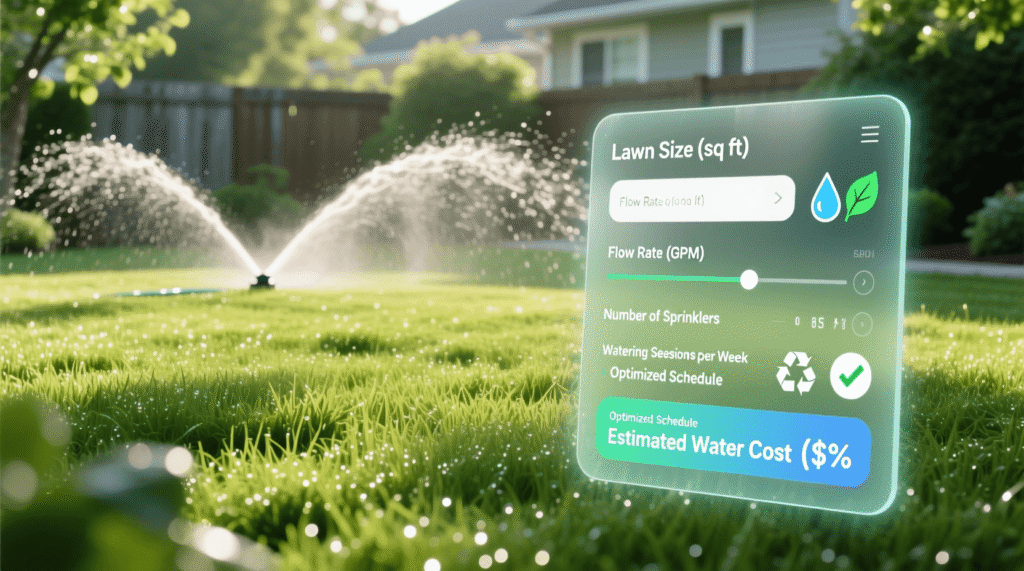
The Lawn Watering Cost Estimator is a tool designed to help homeowners and gardeners understand the financial impact of their irrigation habits. By inputting the specifics of your sprinkler system, watering schedule, and local water tariff, this calculator provides a reliable estimate of your weekly and monthly water consumption (in Litres and cubic meters, m³) and the associated cost. This allows you to monitor expenses, identify opportunities for water conservation, and optimize your watering routine for both your lawn’s health and your budget. For more expert tips and guides on lawn care, visit FarmCityState Lawn & Garden Tips.
Table of Contents
ToggleLawn Watering Cost Estimator
Input your watering schedule and local water price to estimate your monthly usage and cost.
**Note:** Input values editable — adjust flow rate or water price to match your local supplier bill.
**Note:** This estimator is approximate. For exact billing, refer to your water authority.
How to Use the Calculator
Follow these steps to accurately estimate your lawn watering costs:
- Garden / Lawn Area (Optional):
Enter the total size of the area being watered. This helps calculate water usage per square meter (L/m²) for optimization but is not required for the total cost calculation. Select the appropriate unit (m² or ft²). - Flow Rate per Sprinkler / Outlet:
Determine the water flow rate of a single sprinkler head, hose, or irrigation zone. Tip: If the rate is unknown, perform a “bucket test”: run the sprinkler or hose into a bucket for one minute and measure the volume in Litres or Gallons. - Flow Rate Unit:
Select whether the flow rate is measured in Litres per Minute (LPM) or Gallons per Minute (GPM). - Number of Sprinklers / Outlets:
Enter the number of active sprinkler heads, hoses, or zones operating simultaneously during a single session. - Minutes per Watering Session:
Input the typical duration of one watering session in minutes. - Sessions per Week:
Enter the frequency of watering (how many times per week you water). - Water Price:
Enter the price you pay for water. This is usually the cost per cubic meter (m³), equivalent to 1,000 Litres. Check your municipal water bill for this information. - Click “Calculate”:
The results panel will update instantly, showing your estimated weekly and monthly usage, m³ conversion, and total monthly cost.
FAQ – Frequently Asked Questions
Calculation & Units
How is the monthly water usage calculated?
The calculator determines total weekly usage using the formula:Flow Rate × Minutes × Outlets × Sessions per Week
It then multiplies the weekly total by the average number of weeks in a month (4.345) to estimate monthly usage.
Why does the calculator use cubic meters (m³) for billing?
Water utilities typically measure and bill consumption in cubic meters, where 1 m³ equals 1,000 Litres. Using m³ ensures the cost matches utility billing standards.
What should I do if I have different types of sprinklers with different flow rates?
You have two options:
- Average Method: Calculate the flow rate for each type, then use the average flow rate with the total number of outlets.
- Separate Calculation (Recommended): Calculate the cost for each zone or sprinkler type individually, then sum the estimated monthly costs.
Watering Practices
Is it better to water frequently for short periods or infrequently for long periods?
Infrequent but deep watering is better. Deep watering encourages roots to grow downward, making the lawn more drought-resistant and reducing surface evaporation. Aim for 2–3 deep sessions per week instead of 5–7 shallow sessions.
How can I reduce my lawn watering costs?
Optimize Sprinklers: Use low-flow nozzles or switch to drip irrigation for garden beds.
Water Early: Morning watering (4 am–8 am) minimizes evaporation.
Check for Leaks: Even a slow leak can waste hundreds of Litres per month.
Use a Rain Sensor: Automatically skip watering when it rains.
This post contains affiliate links. I may earn a commission if you make a purchase through them, at no extra cost to you.