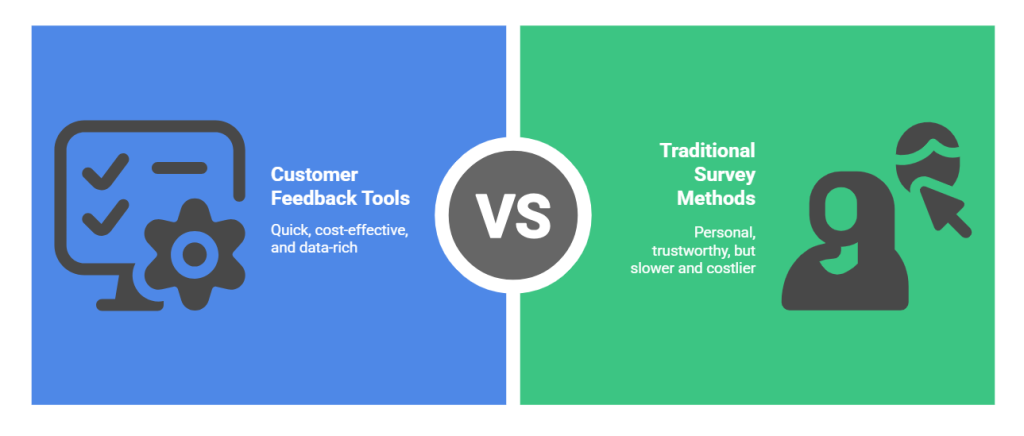
In today’s fast-paced business world, understanding customer needs and gathering their feedback is crucial for growth. However, the way businesses collect this feedback has evolved significantly. While traditional survey methods like paper forms and phone interviews have been around for a long time, the rise of customer feedback tools has made the process easier and faster.
But which one is right for your business? Let’s take a closer look at customer feedback tools vs traditional survey methods to help you make an informed decision.
What Are Traditional Survey Methods?
Traditional survey methods are the older techniques businesses have used for years to collect customer feedback. These methods include paper surveys, phone interviews, and in-person interviews. While these approaches still have their place, they often require more time and effort from both the business and the customer.

The Advantages of Traditional Survey Methods
One of the main benefits of traditional surveys is the personal touch they offer. Whether it’s a phone call or an in-person interview, customers often feel more valued when interacting with a real person. This can lead to more detailed responses.
Traditional surveys allow businesses to ask follow-up questions and probe deeper into customer opinions. This can help gather richer insights that automated surveys might miss.
Traditional survey methods may be more familiar and effective for businesses that cater to older customers or local communities.
The Disadvantages of Traditional Survey Methods
Traditional surveys often take a lot of time to complete. You need to print and distribute paper surveys, make phone calls, or schedule in-person interviews, all of which can be costly and time-consuming.
Traditional surveys are usually limited to a small group of people, and they might not reach a diverse range of customers, especially if your business operates in multiple regions or countries.
People often feel overwhelmed by the number of surveys they are asked to complete. This can lead to low response rates, particularly if the survey is long or complicated.
What Are Customer Feedback Tools?
Customer feedback tools are digital platforms or software that allow businesses to collect feedback from customers using online surveys, forms, polls, and other automated methods. Some popular feedback tools include Google Forms, SurveyMonkey, Typeform, and Qualtrics. These tools are typically faster, more efficient and can reach a larger audience than traditional methods.

The Advantages of Customer Feedback Tools
One of the biggest benefits of using feedback tools is how quickly you can collect and analyze data. With just a few clicks, you can send out surveys to thousands of customers and receive responses almost instantly.
Feedback tools allow businesses to collect data from a global audience. You can use email, social media, or pop-up surveys on your website to reach a diverse range of customers.
Compared to traditional methods, customer feedback tools are generally more affordable. Many of these tools offer free versions, and paid versions usually come with additional features that are still relatively inexpensive.
Most customer feedback tools come with built-in analytics that help you quickly analyze the responses. This can save a lot of time and effort when trying to make sense of large amounts of data.
The Disadvantages of Customer Feedback Tools
While feedback tools are efficient, they lack the personal touch that comes with face-to-face or phone interactions. Some customers might feel less inclined to share detailed feedback in an impersonal online survey.
With the power of technology comes a lot of data. While it’s easy to collect feedback from a large audience, businesses might struggle with analyzing and managing the data if they don’t have the right systems in place.
Some customers might be hesitant to share feedback online due to concerns about privacy and data security. It’s essential to make sure your surveys are secure and that customers know their data will be kept private.
Customer Feedback Tools vs Traditional Survey Methods
When deciding between customer feedback tools and traditional survey methods, several factors must be considered. Each method has its strengths and weaknesses, and the best choice depends on your business needs, goals, and available resources.

Speed and Reach
If you need to gather feedback quickly and from a large number of people, customer feedback tools are the clear winner. These tools allow you to send out surveys to thousands of customers with just a few clicks, and you can analyze the results almost immediately. Traditional survey methods, on the other hand, can take days or even weeks to complete.
For example, if you’re a business that sells products online, you might want to use a tool like SurveyMonkey to send surveys to your customers after they make a purchase. This allows you to get real-time feedback that can help you improve the customer experience.
Data Analysis
Customer feedback tools offer built-in analytics, making it easy to interpret the data you collect. These tools can provide detailed reports, graphs, and charts that make it easier to spot trends and identify areas for improvement.
Traditional surveys, however, often require manual data entry and analysis. If you’re working with a small sample size, this may not be a problem. But if you’re trying to analyze feedback from hundreds or thousands of customers, it can become overwhelming.
Personalization
While customer feedback tools are quick and efficient, they often lack the personal touch of traditional survey methods. If you’re a business that relies on building personal relationships with customers, such as a small local shop or service-based business, traditional surveys may still be a better option.
For example, a small restaurant might prefer to ask customers for feedback face-to-face after a meal. This creates a more personal connection and could lead to more in-depth feedback.
Cost
Traditional survey methods can be expensive, especially if you need to hire staff to make phone calls or conduct in-person interviews. If you’re a small business with a limited budget, customer feedback tools are likely to be the more cost-effective option. Many of these tools offer free versions, with paid versions providing more advanced features at a reasonable price.
Privacy and Trust
In some industries, customers may be more hesitant to provide feedback online due to privacy concerns. If you’re operating in a field where trust is critical—like healthcare or finance—traditional surveys may be a better option. Customers may feel more comfortable sharing their opinions in a more secure, private setting.
How Do They Compare in Real Life?
Let’s put these two side by side. Traditional surveys are like a slow boat. They’re steady but take forever to reach the shore. Customer feedback tools? They’re speedboats—zippy and right on time. Here’s a simple table to show the difference:
| Feature | Traditional Surveys | Customer Feedback Tools |
|---|---|---|
| Speed | Slow (weeks or months) | Fast (instant results) |
| Cost | Cheap (pen and paper) | More (starts at $25/month) |
| Reply Rate | Low (5-10%) | Higher (20-30%) |
| Ease for Customers | Hard (long forms) | Easy (quick taps) |
Which one feels right for you? Traditional surveys win if you’re tiny—like a roadside dhaba with no budget. My cousin runs one in Bengal. He uses paper slips because $25 a month is too much. But feedback tools shine in bigger places. A clothing store I visited in Mumbai used one. They asked, “Like the new collection?” on their site. Next week, they stocked more of what people loved. That’s smart!
The big key here? Customer feedback tools give you answers now, not later. That speed can save a business. Imagine a pet shop hearing, “The dog food’s stale,” and fixing it same day. With old surveys, they’d lose pet parents before knowing why. Which way would keep your customers smiling?

Why Does This Matter in 2025?
The world moves fast now. Customers want to feel heard—like their opinion shapes what you do. A 2023 PwC study says 73% of people pick brands based on experience. Price isn’t enough anymore. In 2025, that’s even truer. People in Kolkata or New York—they all expect quick fixes if something’s wrong.
Traditional surveys can’t keep up. They’re like a rickshaw in a race with cars. Feedback tools match the speed of life. Say you run a saree shop. A tool shows 20 customers hated the checkout line today. You add a second counter tomorrow. With the old methods, you’d miss that chance. Numbers back this up: Businesses using feedback tools grew 15% faster in 2024, according to a small study I read. Isn’t that exciting?
Think of a pet-sitting business. It’s hot in 2025—pets are family! The U.S. pet market hit $275 billion in 2023 and might reach $350 billion by 2027 (Merchize). Use a feedback tool to ask, “How’s your pup today?” Owners love it, and you tweak care fast—like extra walks if they ask. Old surveys? Too slow for Fido’s fans. What business could you start with this idea?
Frequently Asked Questions
What’s the cheapest way to get feedback?
Paper surveys win here. You just need a pen and paper—maybe 10 rupees for 50 sheets. No tech, no fees!
Do feedback tools work for small shops?
Yes! Start with a basic one like SurveyMonkey. It’s $25 a month but can grow with you. Worth it if you want happy regulars.
How fast are feedback tools?
Super fast! You see answers in minutes—like a WhatsApp chat. Old surveys take weeks. Big difference, right?
Conclusion
So, here’s the deal. Traditional surveys are simple and cheap. They’re fine if you’re small or just curious once a year—like a Durga Puja stall checking vibes. But customer feedback tools? They’re the future. They’re quick, smart, and keep customers happy right now. In 2025, that’s gold. Businesses that listen fast win hearts—and wallets.
Which fits you? If you’ve got a tight budget, start with paper. But if you want growth, feedback tools are your friend. I saw a tea vendor in Kolkata switch to a cheap app. Sales jumped because he fixed sugar complaints overnight. Try it yourself—ask customers something small tomorrow. You’ll feel the difference! What do you think—ready to hear your customers loud and clear?
This post contains affiliate links. I may earn a commission if you make a purchase through them, at no extra cost to you.